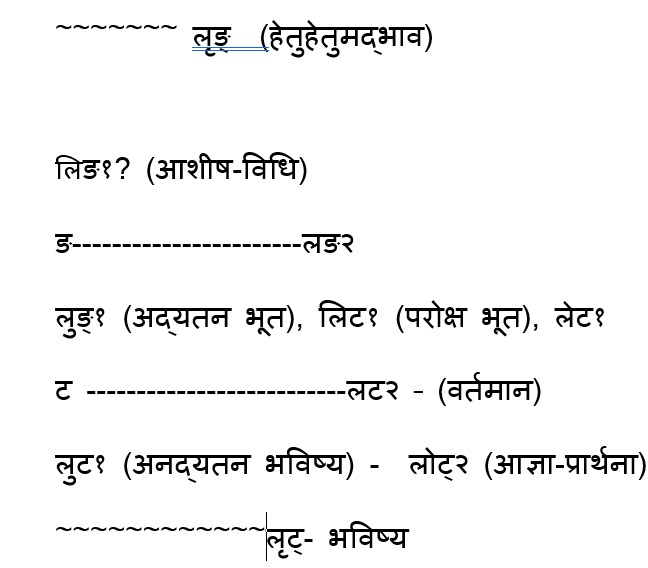
First Stage of लकार evolution
ल is sand/shore. ङ is periphery as seen from shore. You can assume ङ to be high tide mark. ट is sand mound (टीला) or basket made to trap food during tide. ट could have been or evolved in a Coracle from basket.
We are in a Homo society that has yet not developed conception of time. Drives are limbic. Language consists of sentences made up of couple of phonemes. Main use of language is to communicate for hunt, dominance or reproduction.
लकार evolved not as temporal markers but as food marker. It evolved into a temporal marker because tides were time bound.
1 लुङ् = ल उ ङ Sand outward ङ = area towards sea from high tide mark
high tide is over and steady ground is there = food in inter tidal zone is available. अद्यतन means edible and भूत means steady ground accomplished. भुज् has arisen from this context and refers to wide/open steady ground.
लुङ् is food replenishment with each tide. twice a day. It is an annuity without efforts and started causing Homo to stay put in the location.
2 लिट = Sand inward (from) ट
Because टीला holds water, the steady ground is not visible (but is there.) In anticipation this became परोक्ष भूत.
3 लेट = ल ए ट = sand संप्रदान टीला / Coracle
लेट means संप्रदान into ट- receive (food) into ट. It may also mean gather sand into ट.
This is “do this to get that”or “may it be” mood and does not refer to time.
4 लुट = sand outward ट.
This is tide receding completely. Not only this is time of inedible food, it also means food will be available in future only. So लुट means future with fair degree of certainty. This certainty element comes from certainty of tides.
5 लिङ
लिङ = ल इ ङ = sand inward (of) high tide line
Sand beyond high tide line has no chance of getting food and was used for teaching the process.
Hence लिङ was associated with blessing or process instruction.
Alternate meaning: sand below periphery (of boat) when used with तिङ्. Now all लकार are used with verbs तिङ् but initially - before verb subject distinction got crystalized - लकार were place markets as well. When they became action markers - तिङ् interpretation became dominant.
In the second phase floating devices were invented which had to be described differently
6 लृट्
This refers to place inside Coracle afloat. It indicated that food is available in future. But there is no certainty like tide based food.
7 लृङ्
This pertains to situation where instrument is coracle but place if high tide line. This came to mean “IF coracle has cought food THEN we will get it”; so it evolved to mean हेतुहेतुमद्भाव
8 लङ
shoreline is at the high tide level.
Food is not available + steady ground.
9 लट
shire line is at low tide level. Means वर्तमान
10 लोट्
means sand detach from basket. This is maintenance instruction ?
लट् - वर्तमान
sand here ट
Shore line at coracle.
अ - here/at, is plotted on time dimension.
Comment: It is not clear whether it is inward tide or outward. But I believe it is reference to outward tide because context is edible. Whether ट meant coracle or some other instrument of fishing is yet undecided. But calling it Coracle helps me understand and explain concepts as much as some other tool would. It is very unlikely it emerged as coracle. As shore based fishing must predate intentional boat making by a big margin. Whatever that ट, by the time of लृट् it evolved in a coracle type thing. Also by this time temporal conception with ल+ट and ल + ङ was strong enough to name it लृट् and not ट ऋ.
लिट्- परोक्ष – भूत
लिट् = ल इ ट = shore-inward-coracle/ट
भू+क्त - steady up accomplished
Tide is gone hence unseen past
इ -inward - is plotted on time dimension
लुट् = अनद्यतन भविष्य
लुट् = ल उ ट
shore/sand-outward-coracle/ट
उ - outward - is plotted on time dimension.
Comment: The reference point for time is eating and eating is linked to tide. Because Tides re-occur, entire concept of time is re-occurring in cycles.
लृट् भविष्य
लृट् = ल ऋ ट
shore-superior-coracle
comment: लृट् is totally different way of getting food and is not reallty tide related. it is not in अ इ उ dimension but in ऋ - ऌ dimension.
Both लुट and लृट् have “inedible right now” - अनद्यतन - sense. लुट is more certain the way tides are certain. It is very tightly bound to अनद्यतन sense.
लृट् is more uncertain in general. “It is also not very tightly bound to अनद्यतन sense.
लेट् वैदिक
लेट् = ल ए ट
shore-संप्रदान - coracle/ट
concept of संप्रदान is plotted from physical dimension to temporal dimension. Close association with “receiving”/ “attaching” but in non-physical sense.
लोट् आज्ञा-प्रार्थना
लोट् = ल ओ ट
shore-अपादान - Coracle/ट
Comments - अपादान concept from physical dimensions plotted to time dimension. The close association to “giving”/“detaching” but in non-physical sense.
लङ् = लङ् अनद्यतन-भूत = inedible भूत
sand here/at periphery
लिङ् = विधिलिङ् / आशीर्लिङ्
लिङ् = ल इ ङ = shore-inward-periphery/ङ
लुङ् अद्यतन - भूत
लुङ् = ल उ ङ
shore-outward-periphery/ङ- = Edible and भूत (steady shore accomplished)
Edible because food from intertidal zone is available once tide receds
लृङ् = हेतुहेतुमद्भाव
लृङ् = ल ऋ ङ
shore superior periphery = refers to state of learning to swim but with sand below feet.
संप्रदान(existence) verb(float) संप्रदान (existence) verb(float) inside roll+stand untill wave